Category: 📂 Cold War Operative History / TECHINT
Most people know Acoustic Kitty as one of the strangest CIA projects ever attempted, but the real story is more interesting than the meme version. Behind the bizarre headline was a serious Cold War effort to solve a real intelligence problem: how to collect conversations in places where traditional microphones could not reach.
During the 1960s, the CIA's Directorate of Science and Technology and its Office of Research and Development explored whether a cat could be turned into a mobile listening device. The idea sounds absurd today, but it grew out of a period when intelligence agencies were willing to test almost anything that might provide an edge against the Soviet Union. In that world, curiosity and desperation often worked side by side.
Why the CIA Even Tried It
The core problem was simple: Soviet counterintelligence had become very good at finding hidden microphones in buildings, cars, and offices. That made fixed surveillance equipment increasingly unreliable. Intelligence officers needed a way to capture conversations in public spaces where people felt safe speaking freely, especially in locations where a human agent might be noticed immediately.
A cat seemed useful because it could move naturally, blend into the environment, and approach places where a technician would stand out. The theory was that a properly equipped animal could wander into the right area and transmit audio without raising suspicion. In other words, the cat was supposed to become a piece of surveillance hardware with fur, instincts, and excellent camouflage.
That logic was not as ridiculous in context as it sounds now. Cold War intelligence work often relied on improvisation, and agencies regularly pushed technology into uncomfortable territory. If a device could not be hidden in a wall, then maybe it could be hidden in something living. Acoustic Kitty grew out of that exact kind of thinking.
How the System Was Supposed to Work
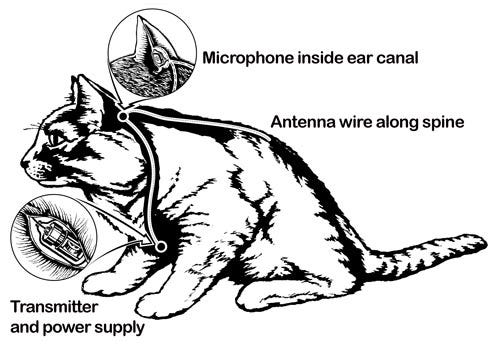
Acoustic Kitty was not just a collar with a microphone. It involved complex surgical work and specialized miniature electronics. According to declassified descriptions, the concept included an implanted microphone, internal transmitter components, and a thin antenna system designed to carry audio signals back to a listening station. The project blended animal training, engineering, and field intelligence in a way that had never really been tried before.
- Microphone: Captured nearby speech from the target area.
- Transmitter: Sent the recorded signal to a monitoring team.
- Antenna system: Allowed the audio to be broadcast over distance.
The idea was to create a platform that could move freely through an environment where bulky equipment would fail. On paper, that sounded brilliant. In practice, it meant turning a living creature into a delicate surveillance system that had to cooperate with both technology and human operators. That is where the plan started to break apart.
Why It Failed
The main issue was not the electronics, but the animal itself. Cats do not follow operational plans, and they are easily distracted by noise, movement, hunger, and instinct. In real-world testing, the CIA discovered that the cat would not reliably go where the operators wanted it to go. That single fact destroyed the basic usefulness of the entire concept.
Even a clever device becomes useless if it cannot be delivered to the right place at the right time. The project never became a dependable field tool because it was always dependent on a subject that could not be controlled like a machine. It was expensive, difficult to manage, and far more fragile than planners expected.
In the end, Acoustic Kitty became a lesson in the gap between invention and deployment. Something can work in a controlled environment and still fail completely once it meets the chaos of the real world. The project was technically ambitious, but operationally unstable from the beginning.
“The challenge was never just building the device. The challenge was persuading a cat to behave like a reliable intelligence asset.”
The Bigger Lesson
Acoustic Kitty is often remembered as a joke, but it also shows how pressure can push governments into unusual solutions. During the Cold War, intelligence agencies did not just compete with each other; they competed with time, secrecy, and the limits of available technology. That pressure encouraged creativity, but it also encouraged risky ideas that would be hard to justify in calmer circumstances.
The project is now a useful case study in TECHINT history because it shows the difference between a clever idea and an operationally useful one. A concept can sound impressive in a laboratory and still collapse the moment it reaches the street. That difference matters in espionage, where failure is often hidden unless it becomes famous later.
What You Can Learn From It
If you are interested in espionage history, Acoustic Kitty is a great example of three important lessons. First, intelligence work often begins with a real problem rather than a strange idea. Second, technology alone does not solve operational problems. Third, when living systems are involved, unpredictability can destroy even the most carefully planned mission.
That is why the story still lasts. It is funny on the surface, but it is also a reminder that intelligence agencies operate in a world where imagination, fear, and technical limits all collide. Acoustic Kitty did not change history, but it did leave behind one of the clearest examples of how far Cold War thinking was willing to go.
- CIA FOIA Electronic Reading Room — Search declassified CIA material on Acoustic Kitty and related Cold War projects.
- The Black Vault: Operation Acoustic Kitty — A strong document archive with declassified files and scans.
- National Security Archive — Excellent for Cold War intelligence documents and analysis.
- Spiegel Geschichte — A high-quality historical article on the CIA's Acoustic Kitty project.
- SOFMAG — A detailed modern overview of the project with references to declassified sources.
Historical Takeaway: Acoustic Kitty remains one of the most famous failures in espionage history, not because the idea was silly from the beginning, but because it reveals how far agencies were willing to go when facing a real intelligence gap. It stands as a reminder that the most creative solution is not always the most usable one.
💬 Comments