Category: 📂 Weird History / World War II / Military Deceptions
The Ghost Army That Fooled Hitler: The Bizarre Genius of Operation Fortitude
In the spring of 1944, the supreme commanders of the Allied forces faced an mathematically impossible dilemma. They were preparing to launch the largest amphibious invasion in human history—D-Day—sending over 150,000 soldiers across the treacherous English Channel to storm the beaches of Nazi-occupied France. The problem? Adolf Hitler and his brilliant field marshal, Erwin Rommel, knew the attack was coming. The Germans had spent years building the Atlantic Wall, a terrifying network of concrete bunkers, landmines, and heavy artillery. If the Nazi panzer divisions figured out exactly where the Allies were going to land, they could easily drive the invading troops back into the sea, effectively winning World War II for Germany. To prevent a catastrophic slaughter, the Allies didn't just need massive firepower; they needed to pull off the most complex, theatrical, and mind-boggling psychological hoax ever conceived. They had to create an entirely fake ghost army from scratch.
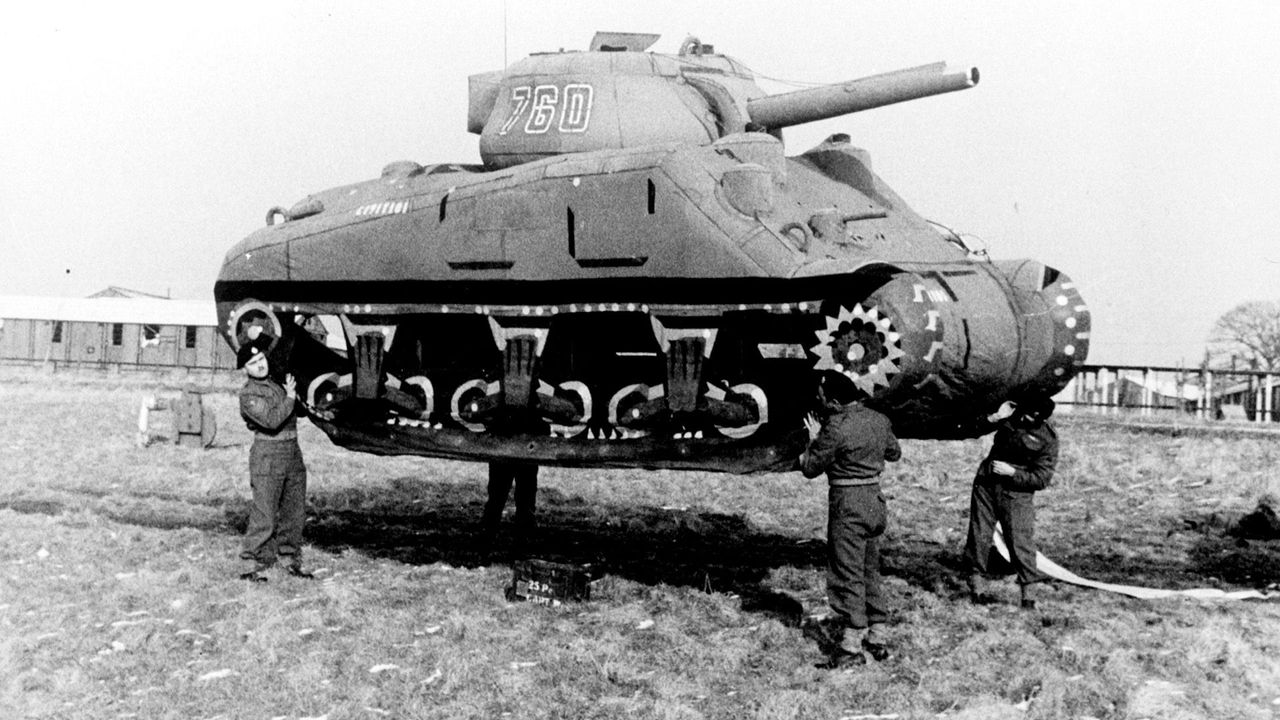
The Ghost Army of Dover: Inflatable Tanks and Canvas Planes
The strategic masterpiece was code-named Operation Fortitude, and its primary objective was beautifully simple yet incredibly daring: make Adolf Hitler believe that the real invasion would happen at Pas-de-Calais, the narrowest point of the English Channel, rather than the actual targets on the beaches of Normandy. To sell this illusion, the Allies created the First United States Army Group (FUSAG). On paper, this was a terrifying force of over 150,000 men, fully equipped with heavy armor, motorized divisions, and landing crafts, positioned directly across the water from Calais in the region of Dover.
In reality, FUSAG did not exist. It was a complete Hollywood stage set constructed in the empty fields of Kent. The Allies hired set designers, artists, and sound engineers instead of traditional combat officers. They built hundreds of incredibly realistic, life-sized tanks made entirely out of inflatable rubber and canvas. From the air, German reconnaissance planes photographed massive armored columns, completely unaware that a couple of British farmers could walk over and lift a 30-ton Sherman tank with their bare hands. Fake airfields were constructed with dummy wooden airplanes parked on the runways, and hundreds of empty canvas tents were erected to mimic massive military encampments. The Allies even designed fake landing docks in British ports, using floating pieces of painted wood and canvas to look like a massive armada of naval ships waiting for the order to sail.
The Patton Factor and the Radio Ghost Towns
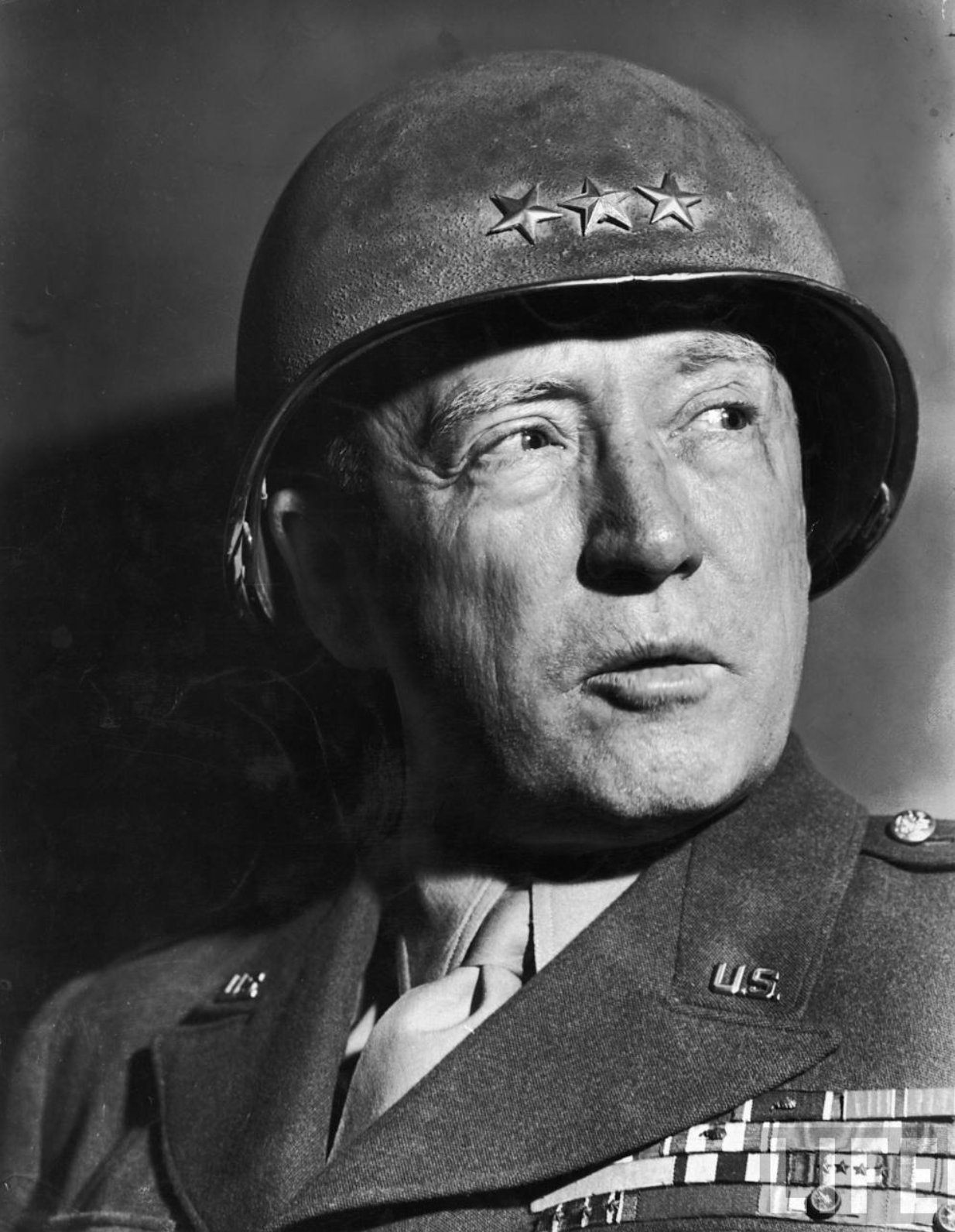
To make the deception completely airtight, the Allies knew they needed a commander that the German High Command genuinely feared and respected. They chose General George S. Patton, America’s most aggressive and successful battlefield strategist. Patton had recently been sidelined due to behavioral issues, making him the perfect candidate for a ghost assignment. The Allies intentionally leaked information that Patton had been given supreme command of FUSAG. Nazi intelligence reasoned that the Allies would never waste their best combat general on a diversionary tactic, which solidified Hitler's absolute conviction that Patton’s non-existent army was the real main threat.
However, visual illusions were only half the battle; the Allies also had to fool the German electronic ear. A tiny group of radio operators traveled through the British countryside, constantly broadcasting a massive web of fake military communications. They simulated regular radio traffic, discussing everything from mundane supply orders for thousands of soldiers to weather updates, sports scores, and fictional unit movements. They even intentionally broadcasted sloppy messages, knowing the Germans would intercept them. German signal intelligence listened to this endless electronic chatter and concluded that a massive, highly active military force was packing its bags in Dover, completely blind to the fact that the real invasion force was silently gathering further west in absolute radio silence.
Agent Garbo: The Double Cross That Sealed the Deal
The most brilliant and cinematic aspect of Operation Fortitude happened inside the dark world of espionage. The Allies utilized a massive network of double agents to feed poisoned information directly to Berlin. The superstar of this operation was a Spanish man named Juan Pujol García, known to the British MI5 by his code name, Agent Garbo. García hated totalitarianism and had managed to trick the German intelligence agency (the Abwehr) into hiring him as a spy. He created a completely fictional network of 27 imaginary sub-agents spread across the UK, sending regular, highly detailed reports back to his German handlers.
Garbo’s information was so consistently accurate that the German high command trusted him blindly, even awarding him the Iron Cross. During the critical weeks leading up to June 1944, Garbo bombarded Berlin with messages confirming that Patton's army was preparing for a massive strike at Calais. Even more astonishingly, in the early morning hours of June 6, as the real Allied landing crafts were hitting the beaches of Normandy, Garbo sent an urgent, high-priority message to Germany. He argued that the Normandy landings were merely a clever, small-scale diversion designed to draw German forces away from Calais, where Patton's main force would strike a few days later. It was a staggering gamble, and it worked flawlessly.
Hitler’s Fatal Hesitation and the Success of D-Day
The psychological trap closed with devastating precision. When reports of the massive landings in Normandy reached Hitler’s headquarters at the Wolf's Lair, the German generals panickingly requested immediate reinforcement from their elite 15th Army, which was stationed at Pas-de-Calais. But Hitler, completely blinded by the fake radio chatter, the inflatable tanks, and Agent Garbo's urgent warnings, refused to move them. He was convinced that he was outsmarting the Allies by keeping his best divisions waiting at Calais to crush Patton’s phantom invasion.
For seven critical weeks following D-Day, as the Allies struggled to secure their foothold on the bloody beaches of France, the massive German 15th Army sat completely idle in Calais, waiting for a ghost army that was never going to show up. By the time Hitler finally realized he had been completely hoodwinked, the Allies had already landed over a million troops, liberated large portions of France, and established an unbreakable western front. Operation Fortitude proved that wars are not just won with bullets, steel, and industrial production; sometimes, a few rubber balloons, a brilliant double agent, and a massive dose of psychological warfare can dismantle an entire empire without firing a single shot.

Sources
- Royal Signals Museum — D-Day Dorset Deception Plan (Interactive Videos & Photos)
- BBC Culture — D-Day Deception: The Army That Didn't Exist (Photos & Full Article)
- YouTube Trailer — 1944: OPERATION FORTITUDE (Cinematic Trailer, 1:30 min)
- YouTube — Watch the Crazy Visual Breakdown of the Sealand War on Our Channel
💬 Comments